 EN


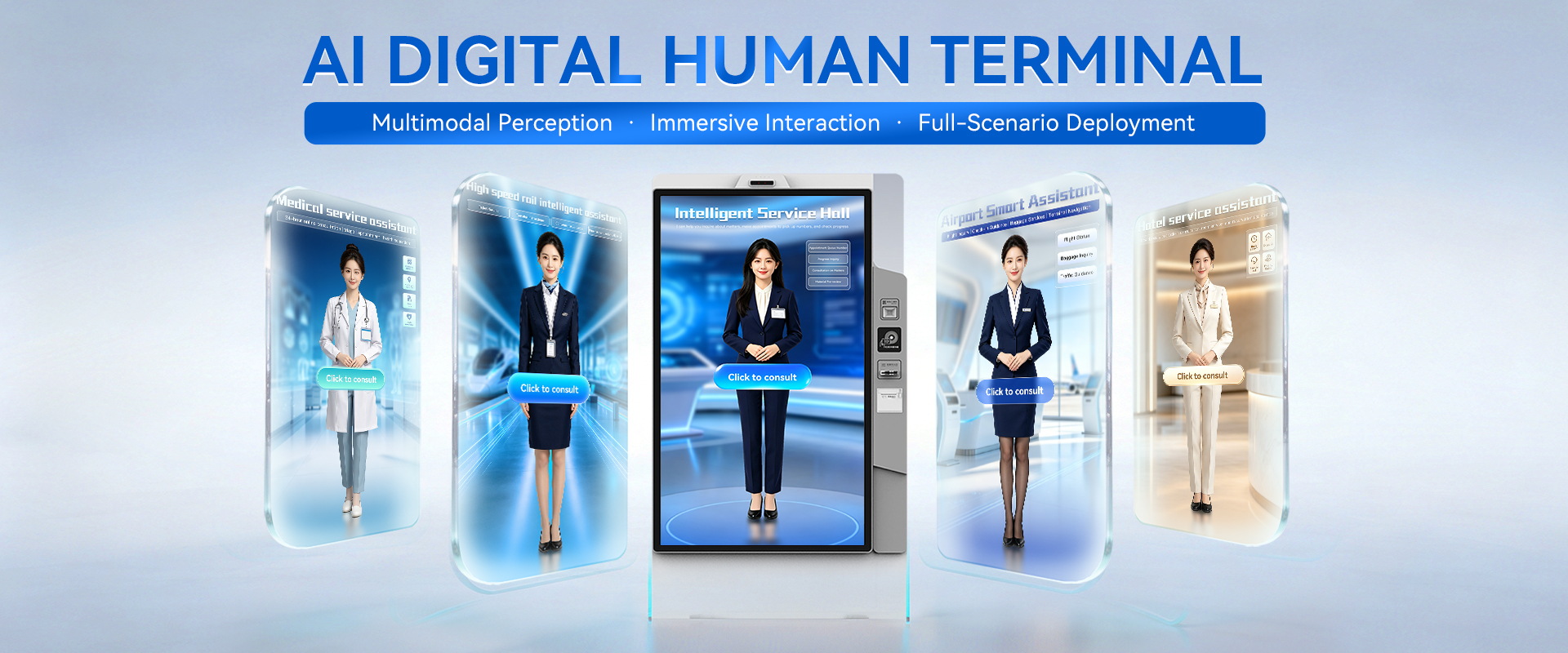
AI Digital Human Series: Redefining Human-System Interaction
From rule-based chatbots to context-aware, emotionally intelligent digital agents
Legacy interfaces rely on rigid decision trees that frustrate users when questions fall outside predefined flows. The AI Digital Human Series replaces this brittle model with multimodal agents that interpret language, visual cues, and vocal tone in real time. Deep learning enables these personas to recognize user intent, respond to shifting context, and adjust emotional register—without scripted escalation. Unlike static chatbots, these agents learn from each interaction, refining responses autonomously. Low-latency speech synthesis and computer vision support fluid dialogue, matching the rhythm of natural conversation. As a result, organizations deliver front-line support that feels less mechanical and more collaborative. Early deployments show fewer dead-end interactions and higher resolution rates—especially in high-volume service environments—shifting automation from task completion to adaptive engagement, where responsiveness and emotional relevance are core design requirements.
Closing the semantic and affective gap in enterprise interfaces
Traditional enterprise systems often understand words but miss meaning, tone, or urgency—the semantic and affective gap between what users say, intend, and feel. Context-aware digital agents narrow this gap by jointly modeling language, sentiment, and situational cues. When a user expresses frustration, the system can acknowledge the emotion, simplify explanations, or escalate thoughtfully. This creates interfaces that are not only accurate but psychologically safer for employees and customers. In practice, closing the gap reduces cognitive load and increases first-contact resolution. It also supports more inclusive service: users with non-standard phrasing or accented speech receive more forgiving interpretation. Over time, these improvements build confidence in automated systems—and strengthen the human-machine partnership central to digital transformation.
Proven Business Impact Across Core Functions
Customer engagement: 37% IVR abandonment reduction via empathetic AI Digital Human Series
Deploying an empathetic AI Digital Human Series in contact centers lowers IVR abandonment by 37%, according to a 2024 industry benchmark. Unlike rigid menu trees, these agents interpret tone, pause, and intent to respond with context-aware reassurance. When callers express frustration, the system adjusts pacing, simplifies options, and escalates only when necessary—keeping customers engaged long enough to resolve issues without transferring to a live agent. The impact compounds: fewer abandoned calls mean lower repeat-contact costs and higher first-contact resolution. A 2024 operational review across high-volume service lines also found a 35% reduction in support calls after deployment, reflecting the series’ ability to preempt common failure points.
Sales & onboarding: Multilingual, compliant AI Digital Human Series accelerating time-to-value
Sales and onboarding workflows often stall due to language barriers or non-compliant guidance. The AI Digital Human Series removes these bottlenecks by delivering multilingual, regulation-aware conversations across regions. Field studies show organizations achieve 40% faster user onboarding (2023), shortening the path to first value. The same deployments report a 25% increase in conversion rates when the series handles product configuration and plan selection (2023). Because compliance checks run in parallel—not as a separate review—the system audits every step in real time. This combination of speed and control helps teams scale onboarding without adding headcount or compromising local legal requirements. As a result, new accounts activate sooner, and sales teams can focus on higher-value conversations.
Operational efficiency: Auditable AI Digital Human Series for HR and IT helpdesk automation
HR and IT helpdesks face high repetition and strict audit demands. An auditable AI Digital Human Series automates password resets, leave requests, and policy lookups while logging each decision trail for later review. In enterprise deployments, this reduces routine support tickets by 35% (2023), freeing specialists for complex cases. The audit log captures user intent, data accessed, and resolution path—simplifying compliance reporting and internal reviews. Training overhead also drops: new employees interact with the same guided workflows, cutting training costs by 60% (2023). These gains accumulate into measurable operational efficiency—fewer escalations, consistent policy enforcement, and improved SLA adherence—while reducing human error in repetitive tasks.
Accelerating Cognitive Workflows with Real-Time AI Digital Human Series
Shrinking decision latency from hours to seconds in dynamic business processes
AI Digital Human Series accelerate cognitive workflows by interpreting multimodal inputs, validating data against enterprise systems, and executing routine actions without human handoffs. In dynamic processes such as claims triage, compliance checks, and supply-chain exceptions, rule-based queues often delay decisions for hours. Context-aware digital agents compress that window to seconds by maintaining conversation state, retrieving policy details, and flagging anomalies for review. Human teams shift from repetitive screen-switching to high-risk exception handling. Each interaction creates an auditable record—supporting governance and continuous improvement. This operational model reduces latency, stabilizes throughput, and keeps control with human decision-makers where judgment matters most—converting slow queues into real-time decision pipelines.
Scalable Industry Adoption: Healthcare, Finance, and Beyond
Healthcare triage: HIPAA-compliant AI Digital Human Series improving resolution speed by 28%
Healthcare systems are adopting HIPAA-compliant digital human interfaces to handle intake and symptom assessment—processing sensitive information securely without exposing protected health information. In a 2024 pilot, providers using an AI Digital Human Series for triage reported a 28% faster resolution speed than scripted phone menus. The system asks contextual follow-ups, reads urgency from tone and phrasing, and routes cases with clinical codes. Similar models are spreading in finance for client verification and public services for eligibility checks. Because the AI Digital Human Series logs every exchange for audit, compliance teams can review decisions transparently. This shifts routine triage from call queues to always-on, auditable conversations—freeing clinicians for complex care while preserving regulatory safeguards.
FAQ
What is the AI Digital Human Series?
The AI Digital Human Series is an advanced technology featuring multimodal digital agents that utilize deep learning to interact with users in real-time, interpreting language, visual cues, and vocal tone to deliver an empathetic and context-aware user experience.
How does the AI Digital Human Series improve customer engagement?
By replacing rigid menu trees with empathetic, context-sensitive communication, the AI Digital Human Series reduces IVR abandonment rates and increases first-contact resolution. It ensures customers receive clear, personalized support, reducing repeat calls and wait times.
How does this technology benefit enterprise operations?
The AI Digital Human Series automates repetitive tasks like password resets and policy lookups while maintaining compliance through detailed audit logs. This approach improves operational efficiency, reduces costs, and ensures consistent service quality.
Can the AI Digital Human Series handle multiple languages and comply with regulations?
Yes, the AI Digital Human Series supports multilingual conversations and integrates regulatory checks in real time. This capability ensures compliance and enhances user experiences across diverse regions and industries.
What industries can benefit from this technology?
Industries such as healthcare, finance, and public services are already benefiting from the AI Digital Human Series. The technology is used for tasks like healthcare triage, client verification in finance, and public service eligibility checks.