 EN


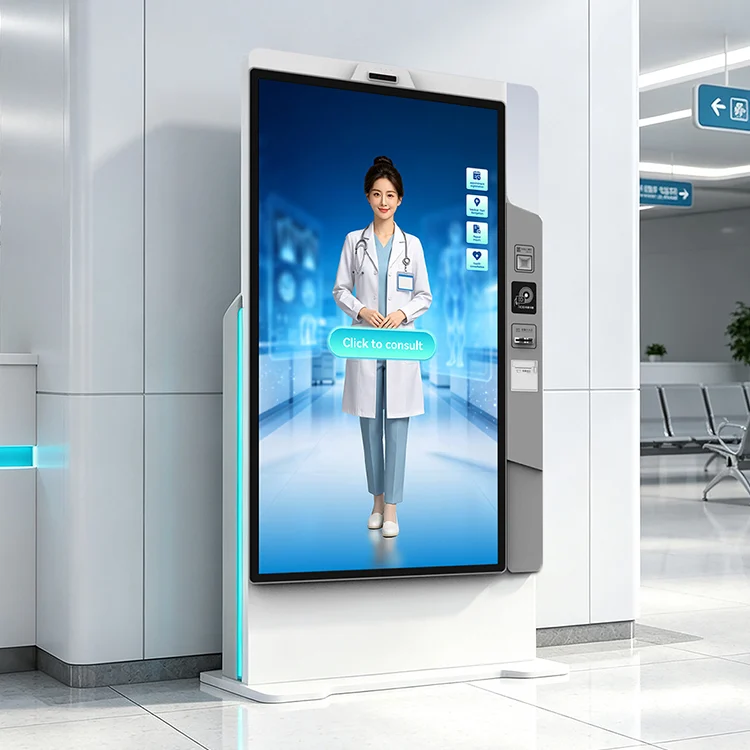
The Strategic Shift: Why AI Digital Human Series Are Replacing Traditional Wayfinding
From static signage to context-aware embodiment: Solving spatial navigation pain points
Exhibition centers have long relied on fixed directional panels, floor decals, and printed map boards—tools built for predictable paths, not dynamic environments. Entrances close, booths relocate, security checkpoints shift, and traffic patterns fluctuate hourly. Static signage cannot adapt in real time. It leaves visitors stranded when the shortest route is blocked or an escalator fails—and offers no personalized support for wheelchair users, time-constrained attendees, or first-time visitors.
The AI Digital Human Series transforms wayfinding by delivering context-aware embodiment. Instead of reading a sign, visitors interact with a lifelike digital human that understands their location, intent, and individual needs. Leveraging live spatial data, occupancy analytics, and event schedules, it delivers directions through natural speech, on-screen map highlights, and intuitive gestures. This resolves core pain points: confusion at decision nodes, language barriers, limited accessibility, and rigidity in changing conditions. Early deployments in large transit venues show a marked reduction in staff-led navigation interventions—visitors receive immediate, multimodal, and situationally relevant guidance.
Key functional advantages over chatbots and voice assistants—especially in multi-language, high-traffic environments
Chatbots and voice assistants fall short in exhibition spaces where physical context and visual presence are essential. A voice-only assistant can’t point toward a hall; a text-based chatbot struggles with accents, background noise, or complex spatial queries. The AI Digital Human Series bridges this gap by unifying voice, gesture, gaze, and visual feedback into one embodied interface.
In a noisy expo hall, visitors can see lip movement, read real-time subtitles, and follow a virtual hand gesture guiding them down the correct aisle. The system supports seamless, real-time multilingual switching—Mandarin speakers hear Mandarin responses while English speakers receive English text—eliminating reliance on multilingual staff or rigid menu-driven kiosks. And unlike human guides or single-threaded interfaces, the digital human scales effortlessly: dozens of visitors can engage simultaneously via multiple concurrent instances. Its use of eye contact, nodding, and expressive facial cues builds trust and reduces the frustration commonly associated with impersonal automation—making it especially effective for international, high-density, and rapidly evolving exhibition layouts.
Enhancing Visitor Experience with AI Digital Human Series
Multimodal engagement (voice, gesture, gaze) and its impact on dwell time and emotional connection
Visitors rarely seek help until confusion turns to frustration—but the AI Digital Human Series intervenes earlier by making interaction feel intuitive and human. It interprets voice, gesture, and gaze as complementary signals: a visitor can point toward a hall, ask aloud, or simply look at the guide—and receive a responsive, natural reply with synchronized speech and body language.
This multimodal design lowers cognitive load and effort compared to traditional kiosks or maps. When interaction feels conversational—not transactional—visitors pause, linger, and explore more deeply. Pilots of context-aware audio guides and virtual agents observed significantly longer contact time and stronger emotional resonance than text-only displays (2023). Social presence matters: appropriate eye contact, responsive nodding, and contextual expressions make exhibition spaces feel more welcoming and less institutional. And because gesture or gaze can compensate when voice input fails in noisy settings, reliability remains high—even in crowded zones. That subtle emotional anchor helps groups stay oriented and more willing to discover adjacent exhibits rather than retreat to exits.
Real-time personalization: Adaptive routing and content delivery based on visitor behavior analytics
Static routes treat all visitors the same—ignoring distinctions between first-time tourists, school groups, and returning professionals. AI Digital Human Series leverages anonymized behavioral signals—dwell time, exhibit preferences, movement speed, and language selection—to tailor guidance in real time.
If a family lingers near interactive science displays, the system may suggest a nearby workshop instead of directing them across the venue. If a visitor repeatedly asks about design history, content delivery shifts toward richer historical context. This adaptive routing saves time and increases perceived relevance. A leading natural history museum used similar behavior-driven personalization in augmented reality tours and reported measurable gains in engagement and satisfaction (2021). The result is not a fixed path, but a continuously updated journey aligned with the visitor’s interest, energy level, and context. In high-traffic centers, this intelligence also eases congestion—gently dispersing flow across underused zones without requiring manual intervention or additional staffing.
Seamless Integration of AI Digital Human Series into Exhibition Infrastructure
Integrating the AI Digital Human Series goes beyond software deployment—it’s about embedding the guide into the physical and operational fabric of the venue. Successful implementations treat the digital human as part of the architecture: wall-mounted displays, entry portals, mobile apps, and information desks all draw from the same real-time spatial model. Leading exhibit designers coordinate lighting, display placement, and edge-network capacity so the guide appears as a natural front-of-house presence—not an afterthought.
Technically, API-first middleware connects the digital human to existing facility systems: access control, room scheduling, digital signage, and emergency alert platforms. Spatial computing and digital twin mapping enable real-time understanding of occupancy density and environmental changes—allowing the system to reroute visitors around congested halls or temporary closures. The outcome is a unified experience: the AI Digital Human Series doesn’t operate in isolation. It functions as a fluent node within the exhibition center’s broader information ecosystem—delivering context-aware guidance while reinforcing consistency, clarity, and continuity across every touchpoint.
Proven Impact: Measuring ROI Through Engagement, Learning, and Operational Efficiency
Knowledge retention uplift (68% vs. text kiosks) and satisfaction metrics from Louvre–MIT and Smithsonian pilots
Rigorous pilots at major cultural institutions confirm that how visitors receive information shapes what they retain. In controlled 2024 studies across Louvre–MIT and Smithsonian venues, the AI Digital Human Series delivered a 68% knowledge retention uplift compared with static text kiosks. Visitors demonstrated significantly stronger recall of exhibit themes, artist names, and spatial relationships after receiving multimodal explanations from a lifelike guide.
Satisfaction metrics mirrored this trend: post-visit surveys showed higher ratings for wayfinding clarity, perceived personal attention, and emotional connection. Voice, gesture, and contextual visuals reduce cognitive load—while conversational turn-taking reinforces memory through active engagement. Crucially, these gains extend beyond novelty: retention improvements persisted across repeat visits and varied language groups, confirming the format’s pedagogical efficacy—not just its appeal. For operators, this establishes a direct link between navigation design and educational outcomes—transforming wayfinding from logistical overhead into a measurable driver of mission impact.
Operational benefits: Reduced staff navigation queries and scalable support across peak attendance periods
Operational data from the same pilot sites reveals a sharp decline in basic wayfinding requests handled by frontline staff. When visitors receive accurate, immediate directions from a digital human—whether at a kiosk or via mobile app—human teams can redirect focus toward safety, accessibility support, and complex visitor needs.
This effect compounds during peak periods: a single digital human instance handles thousands of concurrent interactions without queues, fatigue, or degradation in service quality. Venue managers report reallocating staff hours previously spent on repetitive directions toward crowd management, VIP assistance, and experiential programming. Because the system updates routes in real time and supports multilingual interaction, service consistency holds even amid layout changes or unexpected closures—reducing reliance on seasonal hires. Over time, aggregated interaction logs also surface recurring confusion points, informing strategic improvements to signage, floor plans, and staff deployment. The result is a more agile, resilient, and cost-efficient visitor support model—one that scales with demand, not headcount.
FAQ
What is the AI Digital Human Series?
The AI Digital Human Series is an advanced navigation tool that leverages artificial intelligence to provide real-time, context-aware, and personalized wayfinding assistance through lifelike digital avatars. These avatars use speech, visual cues, and gestures to interact with visitors in venues like exhibition centers and transit hubs.
How does the AI Digital Human Series differ from static signage and traditional wayfinding tools?
Unlike static signage and traditional tools, the AI Digital Human Series integrates live spatial data and real-time analytics, offering visitors personalized guidance. It adapts to changing conditions, such as closed routes or event schedules, and provides support through natural interactions, including voice, gesture, and eye contact.
Can the AI Digital Human Series handle multilingual communication?
Yes, the AI Digital Human Series supports real-time multilingual switching. Visitors can interact in their preferred language, and the system responds in kind using natural speech, text, or visual gestures, making it highly effective in international and diverse settings.
How does the AI Digital Human Series enhance visitor experiences?
The system provides multimodal interaction using voice, gaze, and gestures, making navigation intuitive and engaging. This provides emotional connections and increases dwell time while ensuring a highly responsive and personalized visitor journey through adaptive routing.
What are the operational benefits of implementing the AI Digital Human Series?
Exhibition centers benefit from reduced demand on staff for navigation assistance, scalability during peak visitor times, and data-driven insights for optimizing venue layout and operations. This all leads to improved efficiency and cost savings.
Can the system operate seamlessly within existing venue infrastructures?
Yes, the AI Digital Human Series integrates seamlessly with existing systems like digital signage, access controls, and emergency platforms. It operates as a unified and intelligent component of the venue, ensuring real-time and consistent service.
Table of Contents
- The Strategic Shift: Why AI Digital Human Series Are Replacing Traditional Wayfinding
- Enhancing Visitor Experience with AI Digital Human Series
- Seamless Integration of AI Digital Human Series into Exhibition Infrastructure
- Proven Impact: Measuring ROI Through Engagement, Learning, and Operational Efficiency
-
FAQ
- What is the AI Digital Human Series?
- How does the AI Digital Human Series differ from static signage and traditional wayfinding tools?
- Can the AI Digital Human Series handle multilingual communication?
- How does the AI Digital Human Series enhance visitor experiences?
- What are the operational benefits of implementing the AI Digital Human Series?
- Can the system operate seamlessly within existing venue infrastructures?